
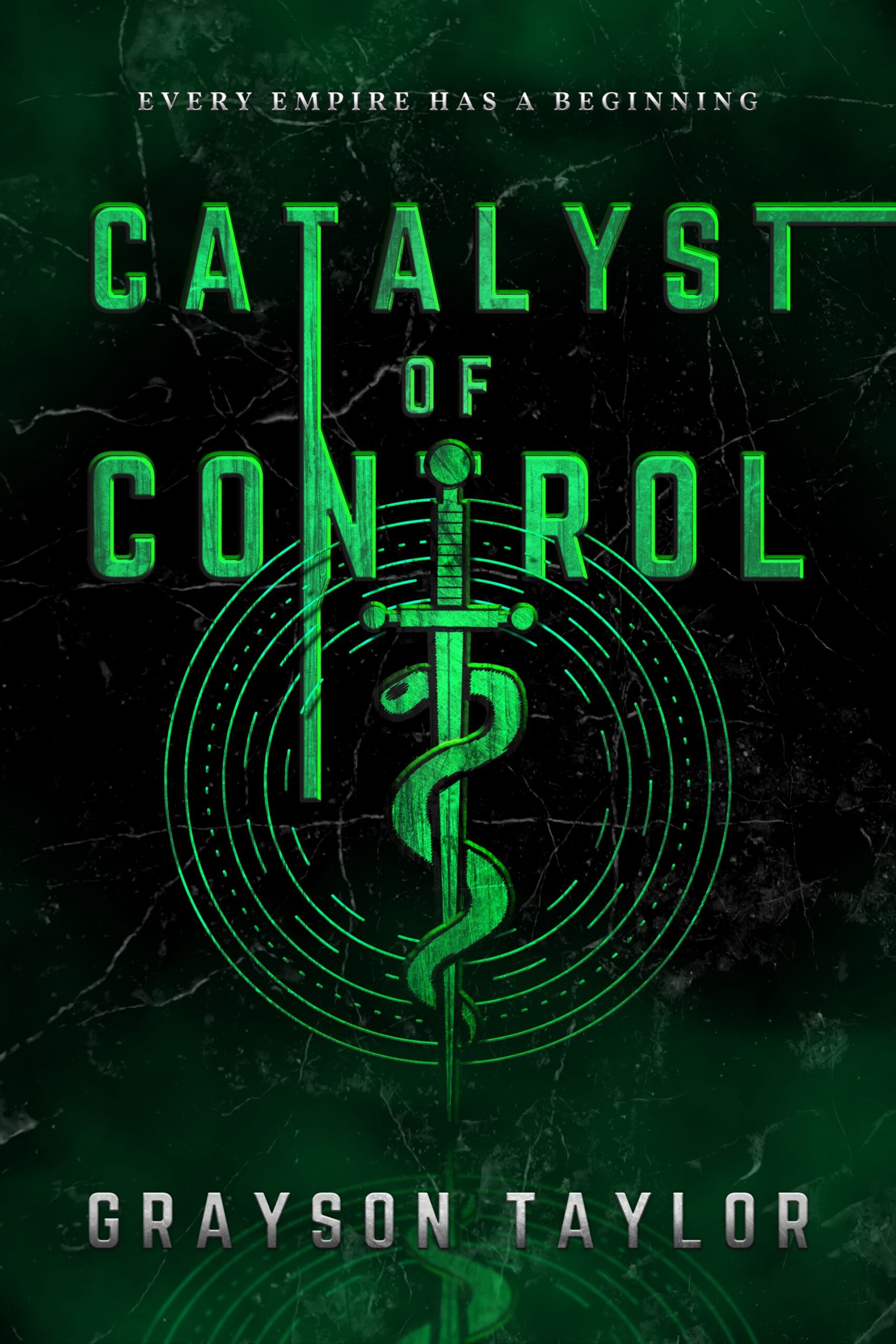
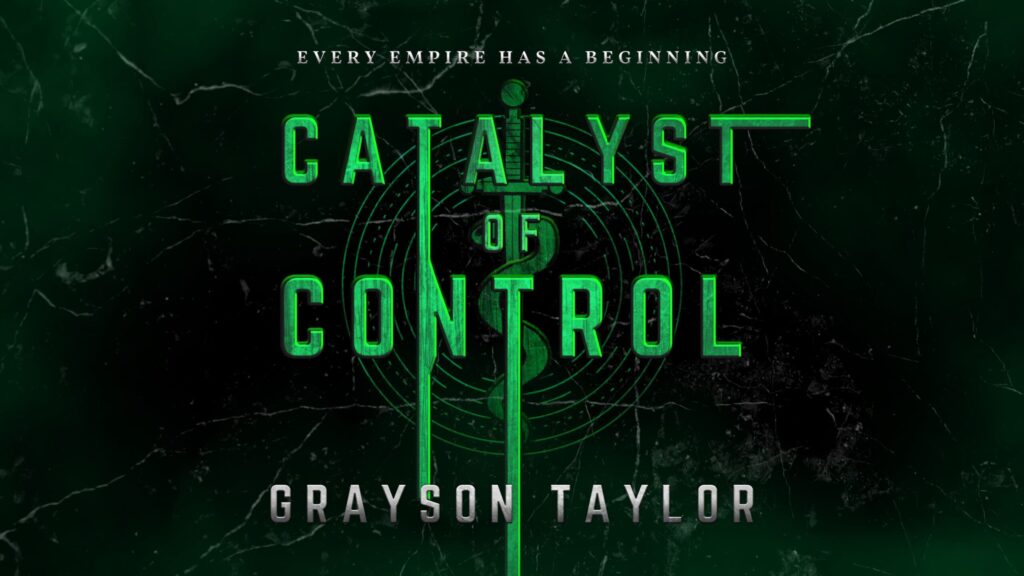
Catalyst of Control
COMING 2026
Science Fiction • Dystopian
As civilization crumbles, a fight to develop quantum mind control rages, and an empire rises from the chaos.

About the Book
Catalyst of Control is the first book in the Fallen Nation Saga, a sci-fi/dystopian series following a collapsing Earth and those fighting to save, or control, its future.
The novel, the ninth by Grayson Taylor, has been in development for six years. It originated as a prequel to his dystopian Fallen Nation trilogy.
Blade Runner 2049 • Andor • Oppenheimer
About the Author
Videos
Music
Articles
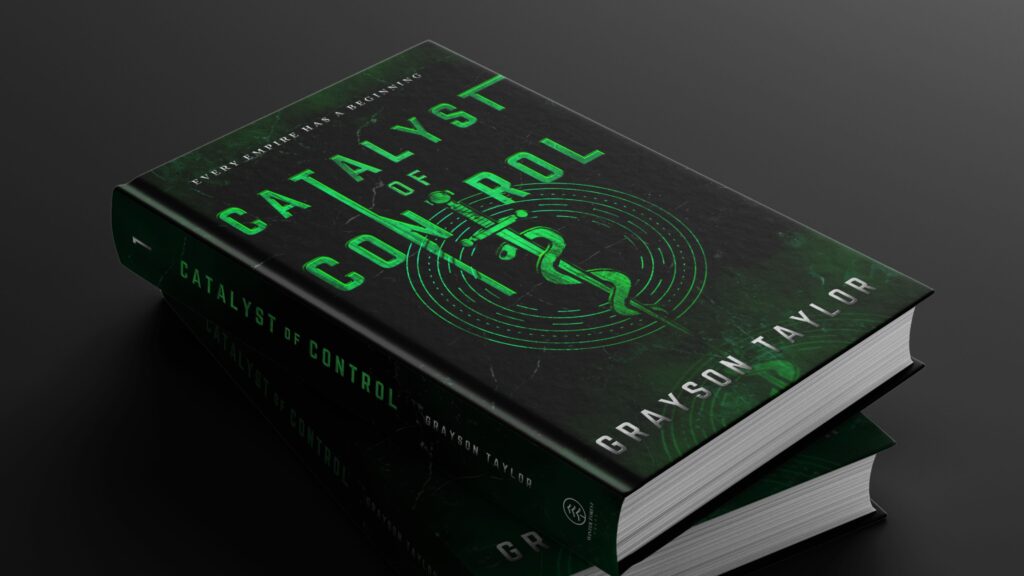
Get Your Copy
ONE
PROTECTOR
“Who are you?”
A voice called from the darkness. Faint, barely audible above the screams and muffled pounding of gunfire.
A boy opened his eyes. Shivering, silent, watching. Waiting.
A white beam cracked through the dark. The glare of a flashlight washed over black water, mud, and concrete. Ash drifted like snow from above.
The searching light landed on the child huddled in the corner, wedged between the curving wall of a sewage tunnel and a metal grate.
For a moment, hope leapt in his heart. They had come back. They hadn’t left him. With a soot-stained hand, he wiped tears from his face. They would want him to be strong.
“Hey. Are you—” The sound of a nearby explosion cut off the words, and more muted screams joined the cacophony. The boy heard a sharp breath through a gas mask. “We need to go.”
The voice was unfamiliar. The hope flickered.
With the sound of shifting rubble, the figure descended into the tunnel. The boy looked past the approaching silhouette at where the roof of the tunnel had caved in. A bomb crater led to the street above, green mist curling at its maw.
“Come on.” A hand extended down to the child. Two fearful eyes regarded it, doubting.
Before the boy could make a choice, the hand took him by the arm and helped him up. The figure guided him to the smoking end of the tunnel, then up the crater to the street.
They emerged from darkness into the dim light of day. Vapor, green as emeralds, coiled around their legs. Tumultuous storm clouds covered a pale sun. Light rain spat down from the heavens. The boy’s breathing sounded close and loud in his ears, trapped in the confines of a gas mask.
The hand on the boy’s arm belonged to a soldier in white and gray camouflage. She, too, wore a gas mask. The boy recognized the flag patch on her shoulder—the red stripes and white star of West America. With a sudden desperation, he pulled away, freeing himself from her grip. He stumbled and fell on his back, struggled to get his hands beneath him, readied himself to run.
The soldier dropped to a crouch and extended an open palm. “Hey. I’m here to help you. I need you to trust me. Can you do that?”
The boy shook his head, backing away.
“What’s your name?”
Before the boy could answer, he heard the whistle of an approaching missile.
The soldier sprang forward, grabbing the boy. They hit the debris beneath them hard, rolling back down the slope of the crater. The soldier shielded the boy as heat rippled over them, accompanied by a deafening blast.
Ears ringing, the child opened his eyes. He felt himself pulled to his feet. Dazed, he followed his protector back up the crater.
They stood up on the black asphalt. Smoke curled across the ground, mingling with the fine green mist blanketing the town. The missile had hit a nearby home, exposing its interior like a wrecked dollhouse. The boy recalled playing with a friend in the living room, though it was now burned beyond recognition.
The soldier set off at a run, the child in tow. Rapid blasts of gunfire echoed through the streets. Plumes of fire and smoke drifted above the housetops.
Hundreds of metal canisters lay in the streets. The child caught glimpses of their reflective shells through the thin mist, sometimes stumbling over them. Each bore the same logo of its manufacturer, circles interlocking beneath the company name. Each was empty, its lethal contents spilled out in a green vapor. Each had rained from the sky, a herald of death.
The only thing more numerous in the streets were the bodies.
A ragged shout sounded from less than a block away, and the grip on the boy’s arm tightened, forcing him to run faster.
In the intersection ahead, another soldier in white and gray camouflage came into view, dragging a thrashing civilian. The soldier ripped the man’s gas mask off, throwing it into the green fog, and kicked him to the ground. Without hesitation, the child’s protector fired from a gun clutched in one hand. The sharp crack of gunfire resounded through the street, and the soldier ahead shuddered and fell backward into the obscurity of the mist.
They crossed through the intersection, the gun in the protector’s hand sweeping the area. There was no one else in sight.
The boy and the soldier slowed to a stop at the end of the road. A large, iron gate topped by barbed wire marked the edge of town. One of its two massive doors was ajar a few inches, the smoking wreck of a car crashed into the other. A body was slumped in the driver’s seat, unmasked. A tattered East American flag hung from atop the gate.
The soldier struggled to pull the gate door open, the metal groaning. When the gap was large enough, the boy slipped between the iron doors and stumbled out the other side.
The moment his protector was through, the child was taken by the arm again, and the two set off at a run away from the gate. Light rain, stirred in a vicious wind, whipped around the child as he ran. The sky flashed white with lightning.
The boy looked back over his shoulder. The border wall of Wrenton, New Hampshire stretched on in either direction. A patchwork of scavenged materials reinforced the crumbling concrete, resembling a barricade at points—chain link fence, shipping containers, metal plates. On this side of the wall lay a desolate stretch of dirt and, up ahead, a forest of pale birch trees. He forced himself to look forward. He knew he would start crying again if he didn’t.
The pair didn’t stop running until they reached the forest. Raindrops spitting down on them, lightning splitting the sky, dirt spraying behind them with every step, they raced through the trees and slowed only when they could no longer see the town. The emerald fog was nowhere in sight.
Finally, the hand let go of the boy’s arm.
He fell against the pale, thin trunk of a birch tree, exhausted. Raindrops prickled his exposed skin, finding a way through the bare branches of the canopy above.
The soldier heaved for breath, glancing around the forest. She removed her gas mask and gestured to the child’s. “You can take it off. Air’s safe here.”
The boy, after slight hesitation, obeyed. The soldier took the mask and stashed both of theirs in a pack. She leaned against a tree, wiping raindrops from her dark face, and took the gun from its strap across her shoulder, inspecting and reloading it. Her hair was short and black, and a faded scar marked the left side of her forehead. A patch on her uniform read Colonel Vaile.
“Are your parents…” Glancing up at the boy, she left the question unfinished. The tears welling in his eyes were answer enough. Her brow furrowed and she looked down, as if fighting off the same feeling, and nodded. “Okay. Okay.” Her jaw clenched. “They wanted me to look out for you.” Her focus returned to the boy, scrutinizing his dark eyes, his curly black hair. “You are… you are Jordan, aren’t you?”
The boy didn’t respond. He knew it was foolish, but for a moment, he had hoped this soldier had been sent for him, that his parents had somehow arranged for this rescue. It wasn’t true. He wasn’t the boy Vaile was supposed to save.
Whatever familiar features Vaile was looking for, she didn’t find. Realization and acceptance followed in quick succession, and only for a split second did she betray any distress. She looked back toward the town. The boy wondered who she was meant to save—a distant relative, probably, on the other side of the war. He wondered if she was already too late.
Calls and cries in the distance. Gunshots, closer. Someone was coming.
Vaile grabbed the boy by the hand again, walking deeper into the forest. When a branch snapped somewhere behind them, she broke out into a run again, and the child struggled to keep up with her pace.
The skeletal arms of the pale trees around them groaned and whispered with the wind. The rain began to fall harder.
A voice rang out from behind them, almost distinct enough to make out the words. The hostile tone was unmistakable.
Vaile and the child emerged from the forest, running onto a precipice jutting out from a cliff. Twenty feet below lay a shallow river, dotted with boulders and rippling with raindrops. On the other side of the river, the rocky bank curved upward, meeting the sloping base of a mountain range. Snow-capped peaks loomed in the sky above, eclipsing the sun.
Vaile slowed to a stop at the edge of the outcrop. She let go of the child’s hand, turning to face him. The shouts from the forest were growing closer. “Go. Get past the mountain range. Get as far away from here as you can.” She nodded toward the edge of the cliff. “Use the ladder.”
The child peered over the side of the precipice. A rope ladder hung from the side, stretching down to the shallow river below.
The boy looked back at his protector, doubtful. Exhaling, she knelt, took a sheathed knife from her belt, and tucked it in his pocket. “I have to find someone. I’ll catch up if I can. Go.”
One last look at his protector, and the child complied. He climbed over the edge of the precipice, finding footing on the dangling ladder, and began to descend. Vaile disappeared from his view.
Moments later, he heard shouting from the forest. Then gunfire.
He climbed down faster.
The child splashed into the shallow river, letting go of the rope ladder and running. Something caught his foot, and he fell into the stream, bruising himself on the rocks. He scrambled to get to his feet, dripping wet, ignoring the pain. The child ran up onto the bank of the shallow river, then started up the base of the mountain. Pushed onward by adrenaline and fear, he ignored the sounds of gunfire and shouting from behind him. The child slowed to a stop only after he’d climbed thirty feet up the mountainside.
He turned and looked down at the cliff across the river. Vaile stood at the very edge of the precipice, gun clutched in both hands, firing into the forest. She paused, and for several long seconds, there was quiet.
Two West American soldiers, clad in the same camouflage as Vaile, sprinted out from the trees. Vaile hit one, who fell face-first into the dirt. Before she could turn her gun on the other, he shot Vaile in the shoulder.
The child watched, shivering, as Vaile returned fire. The shoulder of her dominant arm had been hit, and her shots missed. The soldier grabbed her gun, wrenched it out of her grip, slammed it into her ribs. Vaile fell to one knee, reaching for a pistol strapped to her belt. The soldier kicked her straight in the face. Vaile’s head snapped backward, and she fell hard on her back, her head hanging over the edge of the precipice.
The child couldn’t move. All he could do was watch, and hope.
The soldier pointed the pistol at Vaile’s head and fired.

Kyrus Varden flinched.
It took several moments for a sense of time and place to return. The gunshot still echoed in his head—or perhaps it was only the thunder.
Slowly, as awareness dawned, he began to feel the cold piano keys beneath his fingers. A tremor passed through one hand, and he clenched it into a fist.
He took a deep breath. Reminded himself where he was, who he was. And finally, began to play.
His fingers danced over the keys. Notes echoed through the space, woven together by a masterful player, reverberating from the depths of the grand piano.
Rain coursed down the glass wall separating the piano from the storm. Lightning flashed in staccato bursts, blurred by the curtain of rain. Moonlight washed in through the glass, passing through openings in the dark clouds, casting moving patches of soft illumination on the reflective floor.
A chorus of thunder accompanied the song. Thunder, and the occasional rumble of an explosion.
Distant eruptions of fire glinted through the rain-smeared glass. Pinpricks of orange reflected off the shiny black surface of the grand piano and the floor like small fireworks.
Kyrus continued to play with ease and grace. No pages of music rested above. He knew the piece by heart.
Footsteps approached. Out of the corner of his eye, he saw a figure slowing to a stop in the doorway.
Kyrus relished the last few notes of the song, closing his eyes as the concluding phrase faded into silence.
The man in the doorway smiled. “Beautiful.”
Kyrus traced his fingers over the keys. “Adagio for Hope in G Minor.”
The other man approached the piano, looking out through the glass wall. Several stories below, a bridge extended out into the dark. A mass of bodies writhed and flowed like smoke over the bridge, lit up by flashes of gunfire, screaming with a thousand furious voices. “We don’t have much time.”
“No.” Kyrus took a deep breath. “Looking forward to the gala?”
The other man couldn’t help but laugh. “Have I ever? Only good thing’s the drinks.”
“What, not excited about hearing Dawson sing his own praises for an hour?”
“I’d rather try having a civil conversation with those rioters.”
Kyrus stood up from the bench. The room was a large space for a single instrument, even a grand piano. A minimalist glass chandelier hung from the ceiling two stories above. It wasn’t lit; the moonlight and distant bursts of fire were enough.
A band on Kyrus’s wrist buzzed, and he glanced down at it. “He wants to see me.”
“Now? He hasn’t left yet?”
Kyrus finally looked out at the bridge below. Everything was muted through the glass, small from this distance, and yet he could almost feel the heat of the explosions, see the glinting madness in the rioters’ eyes. Security forces and automated defense systems held them off, but there was no doubt in Kyrus’s mind how this would end. Anarchy would have its way.
This had always been inevitable. The company’s other research and development facilities around East America had shut down in the face of similar threats, leaving only one along the coast of Maine. Built into the cliffside of a peninsula, it was ostensibly the most secure. But not impenetrable. Word must have escaped about the CEO’s visit to the facility, because the size of the riot outside dwarfed the usual protests. Their rage had reached a tipping point.
“Kyrus.”
His hand was trembling. He covered it with his other hand, exhaled deeply.
A strong hand gripped his shoulder. He looked up into the dark, assured face of Anthony Beck. “We’re getting out of here. Don’t need to worry about them.” Beck adjusted Kyrus’s collar, then nodded toward the door. “Best not to leave him waiting.”
The two men headed out of the room. Both wore black suits with fine silver lines running down the sides. As they exited, the door slid soundlessly back into place.
Kyrus ran a hand through his freshly cut black hair. A pair of footsteps echoed in an otherwise silent hallway.
They reached the end, where a door slid open. Beck stepped aside. “Good luck,” he said under his breath, raising his eyebrows. Kyrus nodded, then stepped over the threshold.
On the other side was an expansive office, sparsely decorated. At the back stood a white desk before an illuminated wall of falling water. Glowing white orbs hung from the ceiling.
Kyrus approached the desk and stopped a respectful distance away. An elderly Korean man in a wheelchair sat behind the desk. For several moments, he did not look up at Kyrus, focusing only on the slice of white-frosted crimson cake in front of him. He cut into the cake with a gleaming silver fork, then savored the bite.
He turned his gaze to Kyrus.
“Would you like some?” he asked, his voice weakened and strained with age. The rest of the cake sat on a silver platter at the edge of the desk.
“No, thank you.” Kyrus paused briefly. “If I may…” He looked down at the slice of cake as the elderly man took another bite. “What is this?”
The man behind the desk smiled, his wrinkled skin crinkling further. “Red velvet cake. I had it imported this morning. It’s quite good… the best cake I have ever tasted, I daresay.”
“You know what I mean.”
The smile on the man’s face faded. He looked down at the fork in his hand, halfway to his mouth with another piece of the scarlet cake. “I suppose…” His voice fell to a whisper, darkness tainting the levity in his old eyes. “I know what is coming. As do you.” He took a long, rattling inhale. “I suppose I wanted one last taste of this.”
The man behind the desk put down the fork. “I can no longer run this company.”
It was like hearing the sun refusing to rise. This man, Myung Han, wasn’t merely the leader of the company with his name; he embodied it. As much as Kyrus had come to know him, Han remained a legend beyond full apprehension. Han Enterprises, and the entire industry it led, had rested on this man’s shoulders for decades.
Kyrus started to ask a question, but the old man stopped him. “I want you to hand control to Nari.”
“You won’t tell her yourself?”
Myung Han bowed his head. “We both know the message will be far better received coming from you.”
“Is there anything else you’d like me to tell her?”
For a few seconds, a shadow of conflict passed over Myung’s face. But it cleared quickly, and he carved another bite of the cake with his fork. “No.”
Kyrus waited, wondering if that was true.
Myung straightened up in his wheelchair and looked past him. “A moment alone, Mr. Beck.”
Beck nodded and stepped back. The door slid closed.
Myung pressed his finger to a drawer in the white desk, unlocking it, and took something out. Moving aside the plate on the desk, he placed down a small silver pendant resembling a yin-yang symbol. Two apostrophe shapes, one darker than the other, embraced to form a perfect circle.
“The taegeuk,” Myung said, sliding it toward Kyrus. “Take it. Do not let it fall into other hands.”
“But Nari—”
“Do not show her,” the man insisted. “I trust only you with this.”
Kyrus took the pendant from the desk and tucked it in the breast pocket of his suit. Myung nodded. “Guard it well.”
Another explosion sounded, closer than any before. The faint cracking of gunfire followed. Myung exhaled, his eyes drifting away from Kyrus.
“We cannot stop them,” he said.
“Security can handle it.”
“We both know that is not true, my dear boy.”
“We can blow the bridge. It’ll stop—”
“It will only delay them.” Myung lapsed into silence, lost in thought. “This facility, what it contains, cannot fall into their hands. These… these rioters, they know no reason. They have no boundaries, no sense of what is right. Can you imagine what would happen if they took what we have here?”
“Yes.”
Myung smiled. “No. No, it would be worse.” As he listened to the muted sounds of fighting, his brow furrowed. “This is what happens when people lack direction.” He stared at the opposite wall, but it was as if he saw something far beyond. Shining tears began to well in his eyes. “All I do, I do to fight this chaos. Our beautiful, fragile world is caught in a battle between anarchy and peace. It may not seem our work is part of that… but it is. It all is.” He looked up at Kyrus once more. “You must carry on the work. Fight for me.”
“For you?”
“For me. I have fought this long enough.” He considered what remained of the slice of crimson cake on his plate. “No point in delaying the inevitable.” He took another bite of the cake, and looked up at Kyrus with glistening eyes. “I must join my father, and his father, and all who came before.” He closed his eyes. When he opened them, they were filled with resolve. “Leave. Leave this place and find safety. There is something I must do. You must promise me, whatever happens, you will not come back for me.”
Kyrus started to object, fear and shock registering on his face, but Myung stopped him with a hand.
“Please. I must.” A bittersweet smile. He gazed up at Kyrus almost lovingly, like a master upon his apprentice, a craftsman upon his creation, with the sad, longing look of a last goodbye. “You were born into a world on fire. But in you, I see hope for the future. Do not let it die. Do not let me down.”
Kyrus opened his mouth to respond, and found no words. His gaze lowered to the emblem embossed in silver on the front of his mentor’s desk. The logo of Han Enterprises, the very same printed on the canisters that rained upon his childhood town. Circles interlocking beneath the company name. They represented, in the abstract, the molecular formation of a lethal chemical agent.
This man had taken everything from Kyrus, then given him everything. Han Enterprises had destroyed his childhood, and shown him a way out of the ashes. Myung Han had taken Kyrus under his wing when he was little more than a young American refugee with promise. To follow this order, to abandon his mentor in such an hour, was unthinkable.
“You must trust me,” Myung said. “Go. And remember… remember the white sun.”
Kyrus looked up at the old man, a question in his eyes. Myung only shook his head.
“In the end, all will be clear.” The fork on his plate jittered, and the rumble of a distant explosion reached their ears. “We each have our part to play. Yours, dear boy…” He smiled. “Yours is a glorious one. Never forget who you are, what I taught you, and you will do great things. I believe that.”
Kyrus held back his feelings, held back his instinct to refuse his orders.
“Anything else, sir?”
Myung sat back in his wheelchair. “No.”
Kyrus inclined his head. He finally turned away and headed for the door. The moment his back was turned, tears began to well in his eyes, tears he could never let the old man see.
Kyrus kept walking, and the door slid open.
“You will change the world, Kyrus,” Myung called. “You will change the world.”